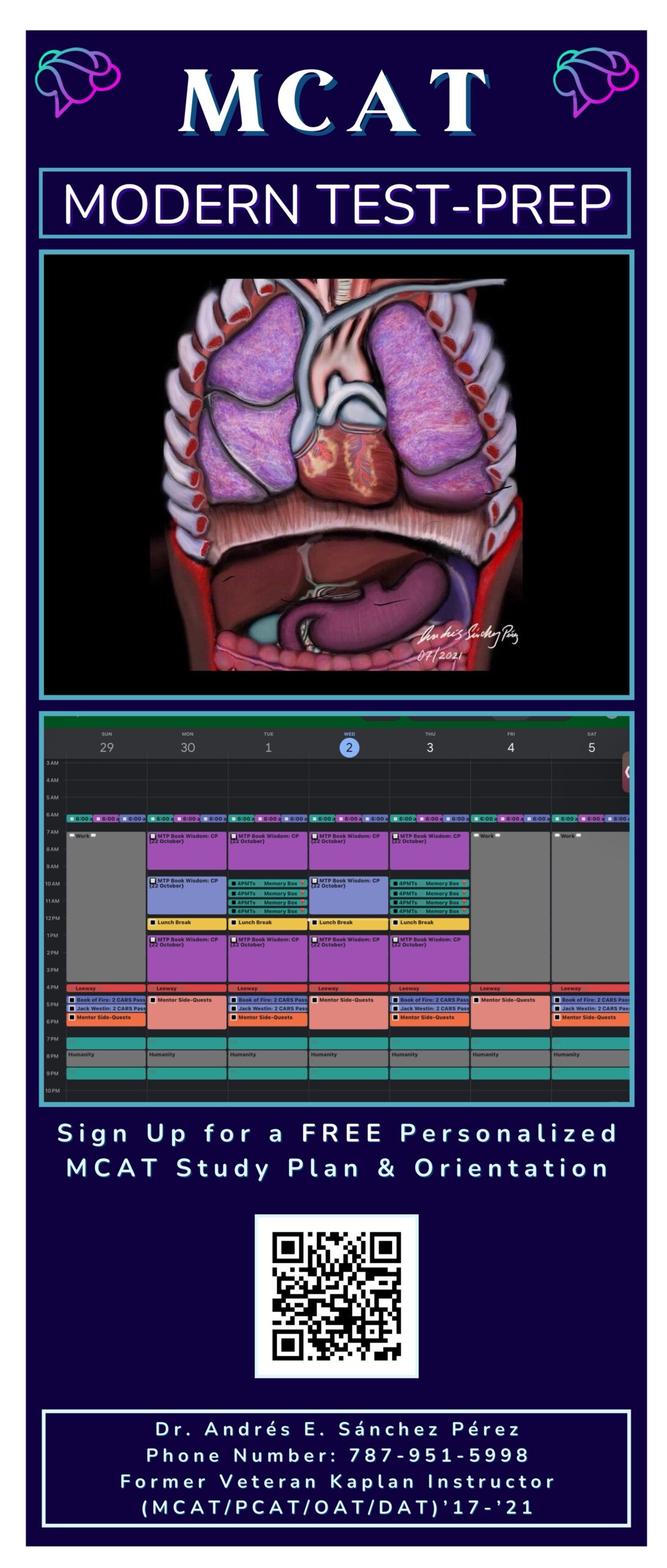
The Mentor Advantage: How 1-on-1 Guidance is Revolutionizing Test Prep in Puerto Rico

The Power of 1-on-1 Test Prep Mentorship in Puerto Rico In the highly competitive world of professional school admissions, the path to a coveted spot in a medical or dental program is paved with high-stakes exams. For students in Puerto Rico aspiring to join the ranks of future physicians and dentists, navigating the complexities of the MCAT, DAT, USMLE, and INBDE can feel like an overwhelming journey. Traditional test preparation methods—large group classes, generic study guides, and solitary self-study—often fall short of providing the personalized, strategic support needed to truly excel. The modern solution, however, is a game-changer: 1-on-1 test prep mentorship in Puerto Rico. This personalized approach is not merely about learning content; it’s about transforming a student’s entire approach to academic challenges, leading to higher scores, increased confidence, and a significant strategic advantage in the admissions process. Beyond the Classroom: The Limitations of Traditional Test Prep For decades, the standard model for test preparation has been a one-size-fits-all approach. Students enroll in massive, expensive classes, where a single instructor lectures to dozens or even hundreds of students. The curriculum is fixed, the pace is set, and individual questions are often lost in the crowd. This model, while accessible, fails to address the unique needs and learning styles of each student. A student who struggles with organic chemistry might be strong in physics, but a standard class moves on regardless. Similarly, a student who needs help with test-taking anxiety receives no special attention. Self-study, while a more flexible option, presents its own set of challenges. Without an external structure or accountability partner, it’s easy to get lost in the vast amount of material. Procrastination becomes a real threat, and without objective feedback, students can misdiagnose their own weaknesses and double down on ineffective strategies. In the high-stakes environment of exams like the MCAT and USMLE, these inefficiencies are not just minor setbacks; they can be the difference between an acceptance letter and a year of reapplication. This is where the profound benefits of a dedicated test prep mentorship in Puerto Rico become undeniably clear. Defining the Mentor Advantage: More Than Just a Tutor The term “mentorship” is distinct from “tutoring.” While a tutor primarily focuses on content—helping a student understand a specific topic or solve a particular problem—a mentor takes a holistic, long-term view. A mentor for high-stakes exams serves as a guide, a coach, and a strategist. They don’t just teach you the content of the MCAT or USMLE; they teach you how to think like a test-taker. They help you build a comprehensive study plan tailored specifically to your strengths and weaknesses. They provide the accountability and motivation needed to stay on track. And crucially, they offer a personalized partnership that evolves as the student progresses, adjusting strategies based on practice test results and real-time feedback. For students in Puerto Rico, this personalized connection is invaluable. Whether you’re preparing for the DAT from a university campus in Mayagüez or studying for the INBDE from your home in Ponce, a good mentor provides a stable, consistent source of expert guidance. They understand the specific challenges of balancing local university coursework with the demands of these international-level exams. They become a trusted confidant and a source of strategic insight, helping to demystify a complex application process. Strategic Benefits for Puerto Rican Students The professional school landscape is highly competitive. For students in Puerto Rico, applying to medical or dental schools, both within the island and on the mainland, requires demonstrating a high level of academic readiness and strategic planning. A high score on a standardized exam is not just a number; it is a powerful credential that demonstrates competence, discipline, and the ability to handle a rigorous academic workload. A dedicated test prep mentorship in Puerto Rico provides this crucial strategic advantage. A mentor can help a student stand out in a crowded applicant pool by: A Deeper Dive: Mentorship for Your Specific Exam The value of 1-on-1 mentorship becomes even clearer when examining the specific demands of each major exam. MCAT Prep with a Mentor The Medical College Admission Test (MCAT) is a beast. It requires not only a deep understanding of biology, chemistry, physics, and psychology but also the ability to apply that knowledge to complex, passage-based questions. An MCAT mentor is an expert strategist who helps students navigate the intricate logic of the exam. They can help you master the art of reading and analyzing scientific passages, a skill that is rarely taught in undergraduate classes. They will guide you through the process of integrating knowledge from multiple disciplines to answer a single question, a core skill for this exam. DAT Prep with a Mentor The Dental Admission Test (DAT) has its own unique quirks, most notably the Perceptual Ability Test (PAT). This section requires specific skills that are difficult to develop with traditional methods. A dedicated DAT tutor or mentor can provide targeted practice and feedback on PAT sections, helping you see patterns and improve your spatial reasoning skills. They also provide comprehensive guidance on the biological and chemical sciences, as well as the reading comprehension sections, ensuring a well-rounded and competitive score. USMLE Prep with a Mentor For medical students, the USMLE (United States Medical Licensing Examination) is the most critical hurdle. The sheer volume of information required for Step 1, Step 2 CK, and Step 3 is staggering. An USMLE guidance mentor helps students create a manageable study schedule that balances the need for content review with the crucial practice of UWorld questions. They can help you identify high-yield topics, refine your clinical reasoning skills, and develop an efficient strategy for approaching the vast question banks. A mentor’s experience can be invaluable for navigating this multi-year process. INBDE Prep with a Mentor The Integrated National Board Dental Examination (INBDE) marks a significant shift from the old format, focusing on integrated clinical scenarios. This requires a different approach to studying. An INBDE preparation mentor, familiar with the new exam’s format and content, can
DAT Perceptual Ability Test: Complete Guide for Puerto Rico Students | MTP

The Importance of the PAT in Dental School Admissions For aspiring dental students, the Perceptual Ability Test (PAT) is one of the most critical and often intimidating sections of the DAT. Unlike the science sections which test content knowledge, the PAT evaluates your innate spatial reasoning and visual manipulation skills. Dental schools view the PAT as a key indicator of manual dexterity and a student’s ability to visualize complex 3D structures, a skill fundamental to the practice of dentistry. For students in Puerto Rico, where the curriculum may focus heavily on foundational sciences, dedicated PAT preparation is essential to ensure a competitive application. This guide will provide a strategic overview of each PAT section and offer actionable techniques to turn your visual aptitude into a high-scoring advantage. Keyholes Strategies: Mastering 3D Object Visualization The Keyholes section challenges your ability to mentally manipulate a 3D object and determine if it can pass through a given keyhole. Success here depends on a systematic approach to visualization and elimination. Step 1: Analyze the Object, Not the Keyhole Before looking at the keyholes, take a moment to understand the object. Identify its unique characteristics. Are there any flat faces? Curved surfaces? Notches or protrusions? Mentally rotate the object to see its profile from different angles. This initial analysis prepares your mind to match the object to a potential keyhole. Step 2: Use the Process of Elimination Examine each keyhole one by one. The most efficient strategy is to quickly eliminate keyholes that are impossible. Look for features in the keyhole that do not exist on the object’s profile. For example, if the object has no square profile from any angle, you can immediately eliminate any keyhole with a perfect square shape. Look for curved vs. straight lines, sharp corners vs. rounded edges. Step 3: Focus on the “Obstacles” When evaluating a potential match, look for parts of the object that would prevent it from passing through the keyhole. This is often a small corner, a bulge, or a specific angle that doesn’t fit. Mentally “slide” the object through the opening, checking for any conflicts. If you’re unsure, save that keyhole for last and use your remaining time to focus on a more likely option. Top-Front-End Views: Understanding Orthographic Projections This section tests your ability to translate a 3D object into three 2D projections. It requires a solid grasp of how a 3D shape appears from different perspectives. Step 1: Isolate Each View Instead of trying to see all three views at once, focus on one at a time. Mentally position yourself to look at the object from the top, then from the front, and finally from the side (the “end” view). Step 2: Use the “L-Shape” Rule A key to success in TFE is understanding that the lines in the front and top views align vertically, while the lines in the front and side views align horizontally. Imagine a simple “L-shape” with the front view at the corner. This helps you ensure that a feature on the front view corresponds to a feature in the same vertical plane on the top view, and the same horizontal plane on the end view. Step 3: Count and Match Count the number of sides and edges in each view. This can help you quickly eliminate choices. For example, if the front view shows a block with four distinct vertical lines, the correct answer’s front view must also have four such lines. This simple counting strategy can save valuable time. Angle Ranking Mastery: Methods for Accurate Discrimination Angle ranking is a visual acuity test that measures your ability to distinguish small differences between angles. It is one of the most frustrating sections, as angles are often extremely close in value. Step 1: The “Reference Angle” Technique Instead of trying to rank all the angles simultaneously, pick a middle-of-the-road angle and use it as your reference. Compare all other angles to this one, categorizing them as “smaller than,” “larger than,” or “very similar to” your reference. Step 2: Look for Clues and Extremes Identify the most acute (smallest) and most obtuse (largest) angles in the set. Placing these extremes first can make the remaining angles easier to rank. Also, look for angles that are clearly a right angle (90∘). Step 3: Avoid the “Visual Guess” Your first visual impression is often wrong. Force yourself to use a more systematic comparison. You can use your pencil or a straight edge (mentally) to extend the lines of the angles and compare them against a common reference point. This is a mental exercise that trains your eye to be more precise. Hole Punching Techniques: Visualizing Folded Paper This section requires you to visualize the unfolding of a piece of paper that has been folded and then punched with holes. The key is to think in reverse. Step 1: Trace the Unfolding Path Mentally “unfold” the paper one fold at a time, working backward from the last fold. Every time you “unfold” the paper, the holes will be reflected across the fold line. Step 2: Understand Symmetry The position of the holes in the final unfolded pattern is directly related to the symmetry of the folding. A fold creates a line of symmetry. Any holes punched on one side of that line will appear on the other when you unfold it. Step 3: Draw it Out For difficult questions, don’t rely solely on your mental visualization. Use your scratch paper to draw a rough representation of the folded paper and the hole. Then, physically “unfold” your drawing step-by-step to see where the holes will appear. Cube Counting Solutions: Efficient Methods for Counting Cube counting tests your ability to count the number of surfaces of cubes that are exposed to view. Step 1: Use a Layered Approach Mentally divide the stack of cubes into layers. Count the exposed faces on the top layer, then the next layer down, and so on. This prevents you from missing any faces and provides a systematic way
Why Puerto Rico Students Choose Modern Test Prep for MCAT
MCAT Preparation in Puerto Rico: A Comprehensive Guide for the Pre-Med Student’s Success For the pre-medical student in Puerto Rico, preparing for the Medical College Admission Test (MCAT) represents far more than a standardized exam; it is the gateway to a future in medicine and a challenge that comes with a unique set of circumstances. Within a distinct educational and cultural environment, aspiring physicians must navigate a path that, while aligned with the U.S. system, possesses its own nuances that can significantly impact the preparation process. At Modern Test Prep, founded by Dr. Andrés Eugenio Sánchez Pérez, we not only recognize these particularities but have built a proven system specifically to address them, having helped hundreds of students gain admission to medical schools both on the island and across the United States mainland. Understanding the Unique Context of the Puerto Rican Pre-Med Student The challenges faced by students in Puerto Rico are multifaceted. First, while the education is of high quality, the academic environment can present differences in curricular focus compared to many institutions on the mainland. This can mean that certain topics fundamental to the MCAT, especially in the areas of Psychological, Social, and Biological Foundations of Behavior, may require an adapted frame of reference. A generic prep program, designed for a predominantly English-speaking mainland audience, often overlooks the need to contextualize these concepts within the social, cultural, and public health reality of Puerto Rico. Second, while many students are bilingual, the MCAT is a demanding exam administered in English, particularly the Critical Analysis and Reasoning Skills (CARS) section. Mastering scientific content is crucial, but the ability to analyze complex, dense, and nuanced texts on philosophy, history, or ethics in a second language adds an extra layer of difficulty. It’s not just about understanding the language but mastering the logic and pacing the exam demands in that language. An effective program must strengthen not only knowledge but also linguistic and analytical agility in academic English. Finally, there is the challenge of accessibility to top-tier resources. Many large mainland prep companies lack a substantial physical presence on the island, and their online courses may not offer the level of personalized mentorship and community support that many students need to thrive. The feeling of preparing in isolation, without a support network that understands their specific challenges, can be a significant barrier to success. The Modern Test Prep Methodology: A Personalized and Contextualized Approach What sets Modern Test Prep apart is our core philosophy: personalization. We recognize that every student learns differently, possesses unique strengths, and has specific weaknesses. We reject the one-size-fits-all approach that characterizes many test prep companies. Instead, we implement a system of one-on-one mentorship that is meticulously tailored to each individual’s learning style, pace, and specific goals. Our process begins with a comprehensive diagnostic assessment that goes beyond merely measuring a score. We analyze error patterns, time management, confidence levels, and specific knowledge gaps. With this data, our team of expert mentors, led by Dr. Sánchez Pérez, designs a strategic and dynamic study plan. This plan is not static; it is continuously adjusted based on the student’s weekly progress, ensuring that every study session is maximized for the highest possible return on effort. Crucially, our deep understanding of the educational landscape in Puerto Rico allows us to provide examples, analogies, and contexts that resonate with local students. When explaining sociological concepts or healthcare systems, we do so with references relevant to the Puerto Rican experience. This not only facilitates comprehension but also fosters a deeper, more memorable connection with the material, transforming abstract preparation into applied and meaningful learning. Exclusive Resources: The Competitive Edge for the Island Student To support our methodology, we have developed proprietary resources considered the most robust and specialized in Puerto Rico. These tools are designed with the specific needs we’ve identified over years of serving the local pre-med community. The Strongest Score Guarantee in Puerto Rico: Our Commitment to Your Success Our confidence in the Modern Test Prep system is so firm that we back it with the strongest score guarantee available in Puerto Rico. This guarantee is not an empty slogan; it is a tangible promise of our unwavering commitment to each student’s success. It means we have refined our method to the point where we can confidently ensure results. For us, your triumph is our triumph, and we structure our programs so that by following our personalized plan and leveraging our exclusive resources, a significant score increase is not a possibility but an expectation. Beyond the MCAT: Comprehensive Preparation for Medical Admission We understand that the journey to medical school does not end with the MCAT. Therefore, our mentorship often extends to include guidance on the entire admissions process. We advise students on selecting schools that align with their profile (both in Puerto Rico and the U.S.), crafting compelling and authentic personal statements, and preparing for interviews. Our goal is to build well-rounded, confident, and nationally competitive candidates. The Importance of Community and Cultural Synergy A unique advantage of preparing locally with Modern Test Prep is the powerful sense of community. Students are not alone; they are part of a cohort of like-minded peers who share the same aspirations and understand the specific pressures of being a pre-med student in Puerto Rico. This network provides invaluable moral support, facilitates study groups, and creates an environment of healthy competition and collaboration. Our mentors, many of whom are themselves products of the island’s education system and have successfully navigated the medical admissions process, serve as relatable role models. This cultural synergy—where mentor and student share a common background—creates a more open, effective, and supportive learning environment than any remote, impersonal online course from the mainland could ever provide. A Foundation for Medical School and Beyond Ultimately, our program is designed to do more than just secure a high MCAT score. We aim to build a stronger foundation for the rigors of medical school. The critical thinking skills, scientific reasoning, discipline, and study