Decoding the USMLE Step 1 Pass/Fail Change: What It Means for Medical Students in Puerto Rico

USMLE Step 1 Pass/Fail: Implications for Medical Students in Puerto Rico The USMLE Step 1, once the most critical numerical score on a medical student’s residency application, has transitioned to a pass/fail format. This monumental change, effective as of January 26, 2022, has fundamentally altered the landscape of medical education and residency applications. For medical students in Puerto Rico, understanding the implications of this shift is not just academic; it’s a strategic necessity. This guide will decode what the change means for your path to residency, from adapting your study strategies to highlighting other crucial aspects of your application. The End of an Era: Why Step 1 Went Pass/Fail For years, the Step 1 three-digit score was the primary metric used by residency program directors to screen thousands of applicants. A high score could open doors to competitive specialties, while a low score could close them. This created a culture of intense stress, burnout, and “cramming” for the exam, often at the expense of a student’s holistic education and well-being. The National Board of Medical Examiners (NBME) and the Federation of State Medical Boards (FSMB) made the change to: The Strategic Shift: The New Importance of Step 2 CK With Step 1 now a binary pass/fail result, the spotlight has decisively moved to the USMLE Step 2 CK. This exam, which assesses a student’s ability to apply medical knowledge to clinical scenarios, has become the new primary objective metric for residency programs. For medical students in Puerto Rico, this means: The USMLE Step 1 Pass/Fail and Residency Applications for Puerto Rican Students While the pass/fail change was intended to level the playing field, it has created new challenges and opportunities, particularly for students from institutions that may be less familiar to mainland U.S. residency program directors. What Program Directors Look for Now Without the Step 1 score to filter applicants, residency programs are increasingly relying on a holistic review process. This means your application is no longer just about exam scores. Other factors have gained significant importance: The Puerto Rico Advantage For USMLE Step 1 pass fail Puerto Rico students, the holistic review shift can be an opportunity. You possess a unique set of skills and experiences that can be highlighted on your application: How to Adapt Your Strategy for Success To thrive in this new landscape, medical students in Puerto Rico should adopt a proactive and multi-faceted strategy. Focus on the Four Pillars of Success Think of your application as a house built on four strong pillars, not just a single exam score. Leverage Mentorship for Step 2 CK With the numerical pressure now on Step 2 CK, personalized mentorship becomes even more valuable. An experienced USMLE guidance mentor can: The change in USMLE Step 1 scoring is a paradigm shift. While it removes some of the anxiety associated with a single high-stakes score, it places greater emphasis on other aspects of your application. For medical students in Puerto Rico, this is an opportunity to stand out not just with your grades, but with your clinical skills, research, and unique cultural background. By adapting your strategy and focusing on a holistic approach, you can successfully navigate this new landscape and secure a spot in the residency program of your dreams.
From Pre-Med to Doctor: A Comprehensive Timeline for Puerto Rican Students

Medical School Timeline Guide for Pre-Med Students in Puerto Rico The dream of becoming a doctor is a noble pursuit, filled with dedication, rigorous study, and profound personal growth. For aspiring physicians in Puerto Rico, navigating the complex journey from a pre-med undergraduate to a medical school white coat requires meticulous planning and strategic execution. It’s a multi-year marathon, not a sprint, and understanding the medical school timeline Puerto Rico is crucial for optimizing your chances of success. This comprehensive guide will break down the essential steps, year by year, from your freshman undergraduate year to the glorious moment of medical school acceptance, specifically tailored for students within the Puerto Rican academic landscape. The Foundation: Freshman Year (Year 1 of Undergraduate Studies) Your first year of university is not too early to start thinking about medical school. This year is all about establishing a strong academic foundation and beginning to explore your interests. Coursework and Academic Excellence Focus on excelling in your introductory science courses. These typically include: Tip: A strong GPA right from the start is paramount. These early science grades set the tone for your academic record. Extracurricular Activities: Early Exploration While extensive clinical experience isn’t expected yet, this is an excellent time to: Building the Profile: Sophomore Year (Year 2 of Undergraduate Studies) Sophomore year is where your pre-med profile truly begins to take shape. You’ll delve deeper into foundational sciences and expand your extracurricular involvement. Core Pre-Med Coursework Continue building your science prerequisites: Tip: These courses are often considered “weed-out” classes. Seek help early if you struggle, and consider forming study groups. Deepening Extracurriculars and Clinical Exposure This is the year to actively seek out meaningful experiences: The Pivotal Year: Junior Year (Year 3 of Undergraduate Studies) Junior year is arguably the most critical period in your medical school timeline Puerto Rico. It’s when you’ll tackle the MCAT and prepare for the application cycle. Advanced Coursework and MCAT Preparation Continued Extracurricular Engagement Identifying Letter of Recommendation Writers Start building relationships with professors and supervisors who can write strong letters of recommendation for your medical school application. The Application Cycle: Senior Year (Year 4 of Undergraduate Studies) Senior year is dedicated to the meticulous process of applying to medical school. This is where all your hard work comes to fruition. Early Spring/Summer (Before Senior Year) Summer/Fall (Senior Year) Fall/Winter (Senior Year) Spring (Senior Year) Gap Year Considerations Many students, including those in Puerto Rico, opt for a “gap year” between undergraduate studies and medical school. This can be a highly beneficial strategy. Why Take a Gap Year? How to Use a Gap Year Effectively Specific Considerations for Puerto Rican Students While the general timeline applies broadly, students in Puerto Rico have unique advantages and considerations. UPR Pre-Med Programs Many students attend the University of Puerto Rico (UPR) system, which has strong pre-medical advising and curricula. Leverage these resources: Applying to Medical School in Puerto Rico Bilingualism and Cultural Competence Your bilingualism (Spanish/English) and cultural competence are significant assets. Highlight these strengths in your applications and interviews, especially if you plan to serve diverse patient populations. Key Takeaways for Success The journey to becoming a doctor is challenging but incredibly rewarding. By understanding and meticulously following this medical school timeline Puerto Rico, you can systematically build a compelling application that stands out, paving your way from a hopeful pre-med student to a future physician.
Financial Planning for Medical School: A Guide for Puerto Rican Students

A Guide for Puerto Rican Students The dream of becoming a doctor is a calling driven by a desire to heal and serve. However, for pre-med students in Puerto Rico, the financial reality of a medical education can feel like a daunting barrier. With the cost of attendance at many medical schools exceeding $300,000, understanding how to navigate the financial landscape is not just a practical necessity—it is a critical component of your pre-medical journey. The prospect of massive debt can be overwhelming, but it should not deter you. With careful planning, strategic decision-making, and a thorough understanding of the resources available, you can finance your medical education and manage your debt responsibly. This guide is designed specifically for Puerto Rican students to demystify the financial process. We will break down the true costs, explore all available aid options, and provide practical strategies for budgeting and loan repayment, empowering you to focus on your studies rather than your finances. Understanding the True Cost of Medical Education The first step in financial planning is understanding the full investment. The “sticker price” of tuition is only the beginning. You must budget for the total Cost of Attendance (COA), which schools calculate annually and includes: Financial Aid Options for Puerto Rican Students Financial aid typically comes in two forms: gift aid (which you don’t repay) and loans (which you do). The goal is to maximize gift aid. Navigating FAFSA and Federal Loan Programs The Free Application for Federal Student Aid (FAFSA) is your gateway to all federal financial aid and most institutional aid. Completing it is non-negotiable. Scholarship Opportunities for Medical Students Scholarships are the best way to reduce debt. Pursue them aggressively. Budgeting Strategies During Medical School Living like a student now will allow you to live like a doctor later without being crushed by debt. Managing Debt and Loan Repayment Plans You will not have to repay your loans while in school, but you must understand your future options. Financial Considerations for Returning to Puerto Rico If you plan to return to practice in Puerto Rico, your financial picture has unique aspects. Seeking Financial Advice and Support Services Do not navigate this alone. Seek out expert help. Balancing Financial Pressures with Academic Demands The stress of finances can impact your academic performance. It is essential to manage this anxiety. Financial planning for medical school is a marathon, not a sprint. For the Puerto Rican student, it requires careful research and proactive management. By understanding the costs, maximizing scholarships, borrowing wisely, and planning for repayment, you can invest confidently in your future. This strategic approach allows you to focus on your ultimate goal: becoming a skilled and compassionate physician for your community, unburdened by preventable financial stress.
The Role of Cultural Competence in Medical School Success for Puerto Rican Students
Medical School Success for Puerto Rican Students For Puerto Rican students embarking on the journey to become physicians, success in medical school is measured by more than just grades and exam scores. It is about evolving into a healer who can connect with, understand, and effectively treat patients from all walks of life. In this endeavor, cultural competence is not merely a soft skill—it is a fundamental clinical tool and a significant asset that you, as a student from Puerto Rico, inherently possess and must continue to develop. Your background provides you with a unique lens through which to view medicine. It offers a deep, intuitive understanding of the Puerto Rican community, its values, and its specific health challenges. This article explores how cultural competence serves as a critical pillar for success in medical school and beyond. We will define what it truly means, how to leverage your cultural and linguistic skills, and how to transform your background into a powerful force for improving patient outcomes and bridging healthcare gaps. Defining Cultural Competence in Healthcare Cultural competence in healthcare is the ability of providers and organizations to effectively deliver health care services that meet the social, cultural, and linguistic needs of patients. It is a continuous journey of learning and self-reflection, not a final destination. It goes beyond simple awareness of cultural differences. It involves: For a medical student, this means being able to take a patient history that is sensitive to cultural norms, understand how a patient’s background might influence their perception of illness and treatment, and ultimately, provide care that is both medically sound and culturally respectful. The Puerto Rican Cultural Perspective in Medicine Your upbringing in Puerto Rico has equipped you with a specific cultural perspective that is highly valuable in medicine. The Puerto Rican cultural framework is often characterized by: Understanding these nuances from the inside gives you a profound advantage in connecting with Puerto Rican patients and acting as a cultural bridge for your colleagues. Bridging Cultural Gaps in Patient Care As a Puerto Rican medical student, you will often find yourself in a unique position to bridge cultural gaps, both for patients and within your medical team. You can help interpret not just language, but meaning. You can explain to a attending physician why a patient’s family is so insistently present at the bedside, framing it not as a disruption but as a crucial source of support. You can gently encourage a patient to ask the questions they may feel are disrespectful to ask their superior. Your ability to navigate both the mainstream medical culture and the patient’s cultural world makes you an invaluable advocate and translator, ensuring that care is effective and misunderstandings are minimized. Leveraging Bilingual Skills in Medical Practice Your bilingualism is one of your most powerful and practical tools. Speaking Spanish fluently is not just about convenience; it is a critical patient safety issue. Always list your Spanish fluency prominently on your CV and discuss it in your medical school interviews. It is a highly sought-after skill. Cultural Considerations in Medical Education Medical education is increasingly emphasizing cultural competence. You will likely encounter courses, workshops, and standardized patient scenarios designed to test these skills. Embrace them. See these not as abstract exercises, but as opportunities to share your perspective. Your lived experience adds depth to classroom discussions on diversity, equity, and inclusion. You can provide real-world examples of the cultural concepts being taught, enriching the learning experience for your entire cohort. Addressing Health Disparities in Puerto Rican Communities Cultural competence is directly linked to health equity. Puerto Rican communities, both on the island and the mainland, face specific health disparities, including higher rates of diabetes, asthma, and hypertension. Your understanding of the social determinants of health—such as economic factors, access to care, and environmental conditions—within these communities is crucial. It allows you to provide more holistic care. You can understand why a patient might struggle to afford medication or eat a specific diet, allowing you to work with them to create a feasible treatment plan rather than one that is doomed to fail due to cultural or socioeconomic irrelevance. Building Trust with Diverse Patient Populations Trust is the foundation of the doctor-patient relationship. Cultural competence is the fastest pathway to building it. For patients from marginalized or minority backgrounds, encountering a healthcare professional who understands their culture can be a profound relief. Your ability to demonstrate respect for cultural norms, communicate effectively, and show genuine understanding immediately lowers barriers. This trust leads to better patient adherence to treatment plans, more honest communication about symptoms and concerns, and ultimately, better health outcomes. Incorporating Cultural Humility in Medical Practice An essential companion to cultural competence is cultural humility. This is a lifelong commitment to self-evaluation and critique, to redressing power imbalances, and to developing mutually beneficial partnerships with communities. It means acknowledging that you cannot be an expert in every culture. Even within the Puerto Rican community, there is immense diversity. Approach each patient with curiosity and a desire to learn from them. Use phrases like, “Help me understand…” or “Tell me more about that.” Cultural humility ensures that your competence does not become a presumption or a stereotype. Resources for Developing Cultural Competence Your learning never stops. Continue to develop this skill through: For the Puerto Rican medical student, cultural competence is far more than a box to check on a curriculum. It is the very heart of effective, compassionate, and equitable patient care. It is the skill that will allow you to excel in medical school, resonate during residency interviews, and ultimately, become the kind of physician who truly makes a difference in the lives of your patients. Embrace your background, commit to continuous learning, and use your unique perspective to become a leader in the medical field.
Navigating the US Medical School Application Process as a Puerto Rican Student
Navigating the US Medical School The dream of attending a medical school in the United States is a powerful goal for many pre-med students in Puerto Rico. While the path is rigorous and complex, it is absolutely achievable with careful planning, strategy, and a deep understanding of the process. Applying from Puerto Rico comes with its own unique set of considerations, from navigating the primary application service to framing your island experiences as strengths that set you apart. This journey involves multiple intricate steps, each demanding attention to detail and self-reflection. It can feel overwhelming, but you are not alone. This guide is designed to demystify the US medical school application process specifically for Puerto Rican students. We will walk through each critical stage, from the initial timeline to handling final decisions, providing you with the knowledge and strategies to present your best possible application to admissions committees. Understanding the AMCAS Application Timeline The American Medical College Application Service (AMCAS) is the centralized application portal for most US medical schools. Timing is everything. The application opens for data entry in early May, and you can submit your application in late May or early June. However, the process begins much earlier. Key Timeline Milestones: Crafting a Compelling Personal Statement Your personal statement is your story. It’s your chance to speak directly to the admissions committee and answer the fundamental question: “Why medicine?” Go beyond simply stating your desire to help people. Use specific, powerful anecdotes from your clinical experiences, research, or life in Puerto Rico that demonstrate your qualities. What unique perspective did volunteering in a local clinic give you? How did overcoming a specific challenge shape your resilience? Weave a narrative that shows your journey, your motivations, and your understanding of the medical profession. For Puerto Rican students, your context is a strength. You can speak authentically about healthcare in your community, your bilingual and bicultural skills, and your desire to serve specific populations. This authentic voice is incredibly compelling. Selecting the Right Medical Schools to Apply To Not all medical schools are the same, and a targeted approach is better than a scattergun one. Research is crucial. Use the Medical School Admission Requirements (MSAR) online database to compare schools. Look at median GPA and MCAT scores to see if you are competitive. More importantly, look for mission statements that resonate with your goals. Do they value community service, research, or serving underserved populations? Many schools highly value linguistic and cultural diversity, which is a direct advantage for applicants from Puerto Rico. Create a balanced list of schools: a few “reach” schools, a solid base of “target” schools where your stats are aligned, and a couple of “safety” schools. Preparing Secondary Applications Efficiently Nearly every medical school will send you a secondary application after reviewing your primary AMCAS application. These require additional essays and come with separate fees. The key to managing secondaries is efficiency. Pre-write your essays. Many secondary prompts are repetitive, focusing on topics like “diversity,” “overcoming challenges,” or “why our school?”. Draft responses to these common prompts during the summer so you are not starting from scratch. When answering “Why our school?”, be specific. Mention specific programs, curricular tracks, or research opportunities that genuinely interest you. This shows you have done your homework and are not just sending a generic application. Securing Strong Letters of Recommendation Strong letters of recommendation provide external validation of your skills and character. Plan this carefully. Most schools require a minimum of three letters: two from science professors and one from a physician or other non-science professor. Choose professors who know you well, not just those from whom you earned an “A.” A letter from a professor in Puerto Rico who can speak to your performance in a challenging course and your personal attributes is invaluable. Provide your recommenders with a “brag packet” to make it easier for them. This should include your resume, personal statement, a list of your accomplishments, and the due date. Always ask politely and give them at least one month’s notice. Interview Preparation and Techniques An interview invitation means a school is seriously interested in you. Now you must confirm their decision. Practice is non-negotiable. Conduct mock interviews with your pre-health advisor, a professor, or a mentor. Practice answering common questions (e.g., “Tell me about yourself,” “Why medicine?”, “What are your strengths and weaknesses?”) and behavioral questions (“Tell me about a time you failed.”). Be prepared to discuss everything on your application, especially your clinical and volunteer experiences in Puerto Rico. Your bilingualism and cultural competence are huge assets; be ready to discuss how they will make you a better physician. Navigating Financial Aid and Scholarships The cost of applying to and attending medical school is high, but financial help is available. The Application Process: The AAMC offers the Fee Assistance Program (FAP) for AMCAS, which can significantly reduce application costs if you qualify.Medical School Costs: Once accepted, you will complete the Free Application for Federal Student Aid (FAFSA) to determine your eligibility for federal loans and grants. Additionally, research scholarships offered by individual medical schools, national organizations like the National Health Service Corps, and Puerto Rican civic and professional associations. Special Considerations for Puerto Rican Applicants Your application from Puerto Rico is unique. Frame your experiences as distinct advantages. Bilingual and Bicultural Skills: Fluency in both Spanish and English is a critical skill in healthcare. Highlight this in your application and interviews. Discuss your ability to connect with a diverse patient population.Understanding of Healthcare Systems: If you have experience in both the Puerto Rican and US healthcare systems, you have a broader perspective. You can speak to health disparities and different models of care.Mission Alignment: Many schools have a mission to serve underserved or Hispanic communities. Your background and stated intent to serve these populations can make you a perfect fit for these schools. Dealing with Waitlists and Rejections This process is competitive, and setbacks are common. How you handle them is a test of
The Importance of Clinical Experience for Medical School Applications from Puerto Rico
The Importance of Clinical Experience for Medical School For aspiring medical students in Puerto Rico, a strong academic record and a competitive MCAT score are essential pillars of your application. However, they are only part of the equation. Admissions committees in the mainland U.S. and on the island are looking for more than just scholars; they are looking for future physicians who understand the reality of a career in medicine. This is where clinical experience becomes not just a box to check, but a fundamental component of a compelling application. Engaging directly with patient care and the healthcare system demonstrates your commitment, exposes you to the realities of the medical field, and provides you with invaluable stories and insights that will shape your personal statement and interviews. For students from Puerto Rico, these experiences also offer a unique opportunity to highlight your understanding of the island’s specific healthcare landscape. This guide will explore why clinical experience is so critical, what opportunities are available to you in Puerto Rico, and how to effectively weave these experiences into your narrative. Why Clinical Experience Matters to Admissions Committees Admissions committees use clinical experience as a key metric to gauge your suitability for a career in medicine. They are investing in your training and want to be confident that you have a realistic understanding of the profession’s demands and rewards. Through these experiences, you prove that you are not just attracted to the idea of being a doctor, but to the actual work of caring for patients. It shows you have tested your commitment. It’s one thing to say you want to help people; it’s another to spend your Saturdays volunteering in a clinic. This demonstrates follow-through and dedication. It provides context for your studies. Biochemistry becomes more meaningful when you’ve seen how a drug affected a patient. Anatomy becomes crucial when you understand its role in surgery. It develops essential soft skills. You learn to communicate with patients from all walks of life, work as part of a healthcare team, and navigate high-stress environments. It gives you authentic stories. The experiences you gather will form the backbone of your personal statement and provide compelling answers during interviews. Types of Clinical Experiences Available in Puerto Rico Puerto Rico offers a rich and diverse healthcare environment in which to gain experience. The key is to seek out roles that bring you into direct contact with patients. Clinical Shadowing: This involves following a physician throughout their workday. It is a passive but invaluable experience that allows you to observe the daily routines, challenges, and decision-making processes of a doctor. You can see different specialties and get a sense of where your own interests might lie. Medical Volunteering: This is an active role where you contribute your time to a healthcare setting. This is often where you get the most direct patient interaction. Common places include hospital wards, emergency rooms, free clinics, and nursing homes. Your tasks might include transporting patients, assisting with paperwork, providing comfort, and supporting clinical staff. Employment in a Clinical Setting: Some students work as medical scribes, EMTs, phlebotomists, or medical assistants. These roles require more training but provide a deep, immersive experience and a much more sophisticated understanding of patient care and medical documentation. Finding Shadowing Opportunities with Local Physicians Finding a physician to shadow can be one of the biggest challenges, but it is far from impossible. Leverage Personal and University Networks: This is your most powerful tool. Start by asking your family doctor, specialists you or your family have seen, and your university’s pre-health advisor. Professors in your science departments may also have connections to physicians they can refer you to. Contact Hospitals Directly: Larger hospitals like Centro Médico, Ashford Presbyterian, or Auxilio Mutuo may have formal observership or volunteer programs. Contact their volunteer services department to inquire about opportunities. Be Professional and Persistent: When you contact a physician, be polite, professional, and clear about your goals. Send a concise email explaining who you are, that you are a pre-med student, and why you are interested in their specific specialty. Always follow up if you don’t hear back. Volunteer Opportunities in Puerto Rican Healthcare Settings Volunteering is often the most accessible way to get started. Public Hospitals and Clinics: The Puerto Rico Department of Health and larger public hospitals often welcome volunteers. The process might be more formalized and require an application, background check, and health screenings. Private Clinics and Non-Profit Organizations: Many private clinics and non-profits, especially those serving underserved communities, are grateful for volunteer help. Organizations like Americorps or local free clinics often have structured programs. Community Health Fairs and Outreach Programs: Keep an eye out for health screenings and community outreach events. These are excellent opportunities to get a high volume of experience in a short time and to see community medicine in action. Documenting and Reflecting on Your Experiences Do not make the mistake of having an experience and forgetting to document it. Start a journal or a digital document from day one. What to Record: Write down the date, hours, and location. Describe what you did and saw. Most importantly, reflect on what you learned. How did it make you feel? What surprised you? What confirmed your desire to be a doctor? Did you witness a specific interaction that taught you about empathy, communication, or resilience? Why It Matters: This journal will be a goldmine when it comes time to write your application. It will provide specific, vivid anecdotes that bring your experiences to life, far beyond simply listing your hours on the application form. Connecting Clinical Experience to Your Personal Statement Your personal statement should tell a story of your journey to medicine. Your clinical experiences are the evidence that supports that story. Instead of saying “I am compassionate,” describe a specific moment from your volunteer work that demonstrates that compassion. Instead of saying “I want to help people,” explain how watching a doctor deliver a difficult diagnosis with empathy showed you what
How to Balance MCAT Prep with University Studies in Puerto Rico | A Guide

How to Balance MCAT Preparation with University Studies in Puerto Rico For pre-med students in Puerto Rico, the dream of becoming a doctor is a powerful motivator. However, the path is paved with significant challenges, not the least of which is the daunting task of preparing for the Medical College Admission Test (MCAT) while simultaneously excelling in demanding university courses. Juggling lecture notes, lab reports, and MCAT practice tests can feel like an impossible balancing act, often leading to stress, burnout, and the fear that one responsibility will overshadow the other. This challenge is particularly acute for students on the island, where the academic environment and resources may differ from those on the mainland. The key to success isn’t just working harder; it’s working smarter. It requires a strategic approach to time management, energy conservation, and leveraging the unique resources available to you. This guide is designed to provide you with a practical roadmap to navigate this hectic period successfully. You will learn how to create a sustainable schedule, integrate your prep into your academic life, and maintain your well-being throughout the process. Understanding the Time Commitment for Both Endeavors The first step to achieving balance is to have a clear, realistic understanding of the demands on your time. Underestimating either commitment is a recipe for overwhelm. A full course load at a university in Puerto Rico typically requires 30-40 hours per week between attending classes, labs, studying, and completing assignments. The MCAT, on the other hand, is a beast of its own. A comprehensive preparation plan generally requires 300-500 hours of study over several months. This breaks down to 15-20 hours per week if you prepare over a 6-month period. Accepting that this will be a time of intense focus is crucial. It means temporarily scaling back on non-essential activities and communicating your goals to friends and family so they can understand your limited availability. Creating an Integrated Schedule That Works Trying to “find” time for MCAT studying is a futile effort; you must intentionally “create” it. The most effective method is to integrate your MCAT prep directly into your weekly university schedule. Prioritizing Tasks and Managing Energy Levels Not all study time is created equal. You will be more effective if you work with your natural energy levels, not against them. Leveraging University Resources for MCAT Prep Your university in Puerto Rico is a treasure trove of resources—many of which you may not be fully utilizing. Strategies for Efficient Studying During Semester When time is limited, efficiency is everything. Passive reading is your enemy. Making the Most of Breaks and Holidays University breaks, such as the summer vacation or winter inter-semester, are golden opportunities for intense MCAT preparation. Dealing with Stress and Academic Pressure This balancing act will be stressful. Ignoring that stress will only make it worse. Seeking Support from Professors and Peers You do not have to do this alone. Building a support system is a sign of strength, not weakness. Maintaining Social and Family Connections Completely isolating yourself is a fast track to burnout. Your relationships are crucial for your emotional well-being. Balancing the MCAT with university studies is one of the greatest challenges a pre-med student in Puerto Rico will face. However, with meticulous planning, efficient study strategies, and a strong support system, it is entirely achievable. Remember, this is a marathon, not a sprint. By embracing a strategic and balanced approach, you can excel in your courses, achieve a competitive MCAT score, and take a confident step toward your dream of becoming a physician.
Beyond the Score: How MTP’s 1-on-1 Mentorship Builds Future Healthcare Leaders in Puerto Rico
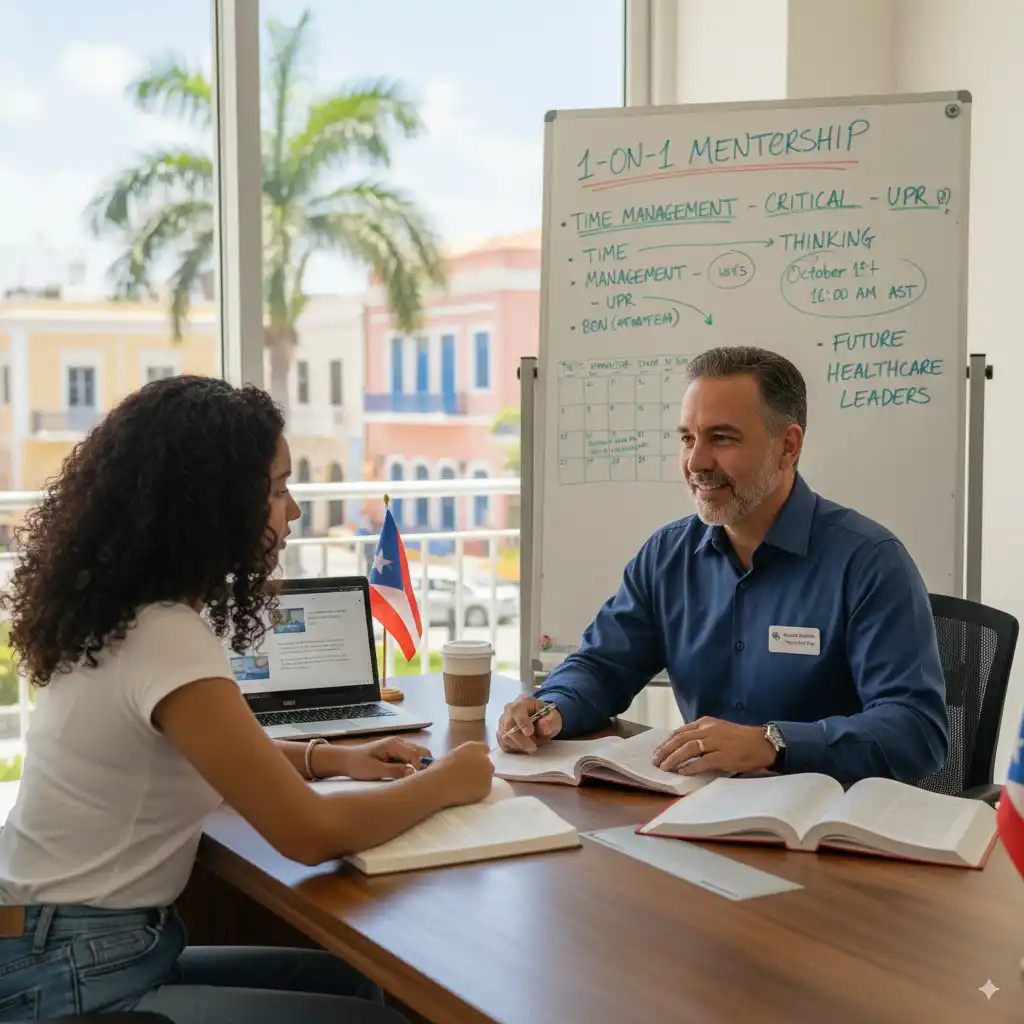
Beyond the Score: How Modern Test Prep’s Mentorship Forges Puerto Rico’s Next Healthcare Leaders For the ambitious pre-med or pre-dental student in Puerto Rico, the path to a white coat is paved with formidable challenges. It’s a journey that demands academic excellence, mental fortitude, and strategic navigation through a complex admissions landscape. While a high exam score on the MCAT, DAT, USMLE, or INBDE is the immediate, tangible goal, achieving it represents just one peak in a vast mountain range. The true challenge lies in developing the resilience, critical thinking, and professional identity required to not only enter the medical field but to thrive within it as a future leader. This holistic philosophy is the cornerstone of Modern Test Prep, championed by its founder, Dr. Andrés Eugenio Sánchez Pérez. The program’s mission moves far beyond the conventional model of content review and practice tests. Instead, it is built on a foundation of comprehensive, 1-on-1 mentorship designed to address the unique academic pressures, cultural context, and career aspirations of students on the island. This isn’t just test preparation; it’s a transformative apprenticeship for a career in healthcare. The Pitfalls of “One-Size-Fits-All” Prep Traditional test prep courses often operate on a conveyor belt model. Dozens of students are fed the same information, the same strategies, and the same timelines. For a student in Puerto Rico, this model is particularly inadequate. It fails to account for: A generic approach leaves these critical factors unaddressed, forcing students to bridge the gap on their own. Modern Test Prep exists to build that bridge. The Mentorship Model: A Personalized Blueprint for Success At its heart, Modern Test Prep is a mentorship program. The 1-on-1 relationship between mentor and student is its most powerful tool. This personalized approach begins with a simple but profound principle: every student learns differently. “Is a student from Bayamón a visual learner who benefits from detailed diagrams and flowcharts? Does a student from Ponce grasp concepts more effectively through auditory discussion and verbal repetition? Our first task is to understand the individual behind the ambition,” explains Dr. Sánchez Pérez. “We then adapt our teaching methods entirely to ensure maximum comprehension and retention for that specific person.” This customization ensures that foundational scientific concepts are not just memorized but deeply understood. However, the mentorship delves much deeper than content delivery. 1. Strategic Academic and Time ManagementThe pre-med curriculum is designed to be demanding. Mentors work with students to deconstruct their weekly schedules, identifying pockets of productive study time and creating realistic, sustainable study plans that align with their academic commitments. This teaches a crucial skill for medical school and beyond: how to manage an overwhelming workload without succumbing to burnout. 2. Advanced Critical Thinking and Analytical ReasoningStandardized tests for healthcare fields are increasingly less about rote memorization and more about problem-solving under pressure. Modern Test Prep’s curriculum is designed to strengthen the cognitive muscles essential for these exams and for clinical practice. Mentors push students to move beyond the “what” and into the “why” and “how.” Through Socratic dialogue and analysis of complex passages, students learn to dissect questions, identify traps, and apply fundamental principles to novel scenarios. This skill is indispensable for the critical reasoning sections of the MCAT and for diagnosing patients in a future clinic. 3. Stress and Psychological ResilienceThe pressure surrounding these exams is immense. For many students, their entire future feels like it hinges on a single score. This anxiety can be paralyzing and is often the single biggest obstacle to performance. Modern Test Prep integrates stress management techniques directly into its mentorship. Students learn evidence-based methods for managing test-day anxiety, maintaining focus during long study sessions, and developing a mindset of resilience. This transforms the exam from a terrifying monster into a challenging, yet manageable, obstacle—a mindset that is equally valuable when facing a high-pressure emergency room shift or a complex surgical procedure. Navigating the Crossroads: Puerto Rico and the Mainland One of the most unique and valuable aspects of Modern Test Prep’s guidance is its expertise in helping students navigate the admissions process as Puerto Rican applicants. The journey to a healthcare career often involves applying to institutions both locally and on the mainland, each with its own set of expectations. “A common concern among students is how their background and education will be perceived,” notes Dr. Sánchez Pérez. “Our role is to help them reframe that narrative. Their experience in Puerto Rico is not a disadvantage; it is a distinctive asset.” Mentors provide specialized guidance on: This specialized support ensures that students don’t just get a score; they get a strategy for presenting their whole selves in the most authentic and effective way possible. The Ultimate Goal: Readiness for a Profession, Not Just an Exam The final, and perhaps most important, layer of Modern Test Prep’s philosophy is the cultivation of professional identity. The mentor, often a healthcare professional like Dr. Sánchez Pérez themselves, serves as a living example of what the student is working toward. Discussions often extend beyond biochemistry formulas and into the ethics of medicine, the challenges of the healthcare system, and the importance of cultural competency when treating diverse patient populations. This shifts the student’s perspective from a short-term “I need to pass a test” to a long-term “I am preparing to become a doctor.” This long-view approach is what truly forges leaders. It produces healthcare professionals who are not only technically proficient but also empathetic, strategic, and resilient. They enter their programs not as overwhelmed first-years, but as focused individuals who have already mastered the skills of learning, analysis, and self-care. Conclusion: An Investment in Puerto Rico’s Future Choosing a test prep program is a significant decision. It is an investment of time, resources, and hope. By choosing a mentorship model like Modern Test Prep, students are investing in more than a score; they are investing in a transformation. They emerge with a competitive exam result, yes. But more importantly, they emerge with a refined skill set in critical