The Importance of Clinical Experience for Medical School Applications from Puerto Rico

The Importance of Clinical Experience for Medical School For aspiring medical students in Puerto Rico, a strong academic record and a competitive MCAT score are essential pillars of your application. However, they are only part of the equation. Admissions committees in the mainland U.S. and on the island are looking for more than just scholars; they are looking for future physicians who understand the reality of a career in medicine. This is where clinical experience becomes not just a box to check, but a fundamental component of a compelling application. Engaging directly with patient care and the healthcare system demonstrates your commitment, exposes you to the realities of the medical field, and provides you with invaluable stories and insights that will shape your personal statement and interviews. For students from Puerto Rico, these experiences also offer a unique opportunity to highlight your understanding of the island’s specific healthcare landscape. This guide will explore why clinical experience is so critical, what opportunities are available to you in Puerto Rico, and how to effectively weave these experiences into your narrative. Why Clinical Experience Matters to Admissions Committees Admissions committees use clinical experience as a key metric to gauge your suitability for a career in medicine. They are investing in your training and want to be confident that you have a realistic understanding of the profession’s demands and rewards. Through these experiences, you prove that you are not just attracted to the idea of being a doctor, but to the actual work of caring for patients. It shows you have tested your commitment. It’s one thing to say you want to help people; it’s another to spend your Saturdays volunteering in a clinic. This demonstrates follow-through and dedication. It provides context for your studies. Biochemistry becomes more meaningful when you’ve seen how a drug affected a patient. Anatomy becomes crucial when you understand its role in surgery. It develops essential soft skills. You learn to communicate with patients from all walks of life, work as part of a healthcare team, and navigate high-stress environments. It gives you authentic stories. The experiences you gather will form the backbone of your personal statement and provide compelling answers during interviews. Types of Clinical Experiences Available in Puerto Rico Puerto Rico offers a rich and diverse healthcare environment in which to gain experience. The key is to seek out roles that bring you into direct contact with patients. Clinical Shadowing: This involves following a physician throughout their workday. It is a passive but invaluable experience that allows you to observe the daily routines, challenges, and decision-making processes of a doctor. You can see different specialties and get a sense of where your own interests might lie. Medical Volunteering: This is an active role where you contribute your time to a healthcare setting. This is often where you get the most direct patient interaction. Common places include hospital wards, emergency rooms, free clinics, and nursing homes. Your tasks might include transporting patients, assisting with paperwork, providing comfort, and supporting clinical staff. Employment in a Clinical Setting: Some students work as medical scribes, EMTs, phlebotomists, or medical assistants. These roles require more training but provide a deep, immersive experience and a much more sophisticated understanding of patient care and medical documentation. Finding Shadowing Opportunities with Local Physicians Finding a physician to shadow can be one of the biggest challenges, but it is far from impossible. Leverage Personal and University Networks: This is your most powerful tool. Start by asking your family doctor, specialists you or your family have seen, and your university’s pre-health advisor. Professors in your science departments may also have connections to physicians they can refer you to. Contact Hospitals Directly: Larger hospitals like Centro Médico, Ashford Presbyterian, or Auxilio Mutuo may have formal observership or volunteer programs. Contact their volunteer services department to inquire about opportunities. Be Professional and Persistent: When you contact a physician, be polite, professional, and clear about your goals. Send a concise email explaining who you are, that you are a pre-med student, and why you are interested in their specific specialty. Always follow up if you don’t hear back. Volunteer Opportunities in Puerto Rican Healthcare Settings Volunteering is often the most accessible way to get started. Public Hospitals and Clinics: The Puerto Rico Department of Health and larger public hospitals often welcome volunteers. The process might be more formalized and require an application, background check, and health screenings. Private Clinics and Non-Profit Organizations: Many private clinics and non-profits, especially those serving underserved communities, are grateful for volunteer help. Organizations like Americorps or local free clinics often have structured programs. Community Health Fairs and Outreach Programs: Keep an eye out for health screenings and community outreach events. These are excellent opportunities to get a high volume of experience in a short time and to see community medicine in action. Documenting and Reflecting on Your Experiences Do not make the mistake of having an experience and forgetting to document it. Start a journal or a digital document from day one. What to Record: Write down the date, hours, and location. Describe what you did and saw. Most importantly, reflect on what you learned. How did it make you feel? What surprised you? What confirmed your desire to be a doctor? Did you witness a specific interaction that taught you about empathy, communication, or resilience? Why It Matters: This journal will be a goldmine when it comes time to write your application. It will provide specific, vivid anecdotes that bring your experiences to life, far beyond simply listing your hours on the application form. Connecting Clinical Experience to Your Personal Statement Your personal statement should tell a story of your journey to medicine. Your clinical experiences are the evidence that supports that story. Instead of saying “I am compassionate,” describe a specific moment from your volunteer work that demonstrates that compassion. Instead of saying “I want to help people,” explain how watching a doctor deliver a difficult diagnosis with empathy showed you what
How to Balance MCAT Prep with University Studies in Puerto Rico | A Guide

How to Balance MCAT Preparation with University Studies in Puerto Rico For pre-med students in Puerto Rico, the dream of becoming a doctor is a powerful motivator. However, the path is paved with significant challenges, not the least of which is the daunting task of preparing for the Medical College Admission Test (MCAT) while simultaneously excelling in demanding university courses. Juggling lecture notes, lab reports, and MCAT practice tests can feel like an impossible balancing act, often leading to stress, burnout, and the fear that one responsibility will overshadow the other. This challenge is particularly acute for students on the island, where the academic environment and resources may differ from those on the mainland. The key to success isn’t just working harder; it’s working smarter. It requires a strategic approach to time management, energy conservation, and leveraging the unique resources available to you. This guide is designed to provide you with a practical roadmap to navigate this hectic period successfully. You will learn how to create a sustainable schedule, integrate your prep into your academic life, and maintain your well-being throughout the process. Understanding the Time Commitment for Both Endeavors The first step to achieving balance is to have a clear, realistic understanding of the demands on your time. Underestimating either commitment is a recipe for overwhelm. A full course load at a university in Puerto Rico typically requires 30-40 hours per week between attending classes, labs, studying, and completing assignments. The MCAT, on the other hand, is a beast of its own. A comprehensive preparation plan generally requires 300-500 hours of study over several months. This breaks down to 15-20 hours per week if you prepare over a 6-month period. Accepting that this will be a time of intense focus is crucial. It means temporarily scaling back on non-essential activities and communicating your goals to friends and family so they can understand your limited availability. Creating an Integrated Schedule That Works Trying to “find” time for MCAT studying is a futile effort; you must intentionally “create” it. The most effective method is to integrate your MCAT prep directly into your weekly university schedule. Prioritizing Tasks and Managing Energy Levels Not all study time is created equal. You will be more effective if you work with your natural energy levels, not against them. Leveraging University Resources for MCAT Prep Your university in Puerto Rico is a treasure trove of resources—many of which you may not be fully utilizing. Strategies for Efficient Studying During Semester When time is limited, efficiency is everything. Passive reading is your enemy. Making the Most of Breaks and Holidays University breaks, such as the summer vacation or winter inter-semester, are golden opportunities for intense MCAT preparation. Dealing with Stress and Academic Pressure This balancing act will be stressful. Ignoring that stress will only make it worse. Seeking Support from Professors and Peers You do not have to do this alone. Building a support system is a sign of strength, not weakness. Maintaining Social and Family Connections Completely isolating yourself is a fast track to burnout. Your relationships are crucial for your emotional well-being. Balancing the MCAT with university studies is one of the greatest challenges a pre-med student in Puerto Rico will face. However, with meticulous planning, efficient study strategies, and a strong support system, it is entirely achievable. Remember, this is a marathon, not a sprint. By embracing a strategic and balanced approach, you can excel in your courses, achieve a competitive MCAT score, and take a confident step toward your dream of becoming a physician.
The Ultimate Guide to DAT Preparation for Aspiring Dentists in Puerto Rico

The Ultimate Guide to DAT Preparation for Aspiring Dentists in Puerto Rico The dream of becoming a dentist is a powerful one, driven by a desire to improve oral health, create beautiful smiles, and serve your community. For aspiring dentists in Puerto Rico, the path to achieving this dream runs directly through the Dental Admission Test (DAT). This standardized exam is a critical component of your dental school application, a benchmark that admissions committees use to assess your academic readiness and scientific proficiency. The journey can seem daunting, especially when considering the unique context of preparing for a rigorous exam like the DAT on the island. You may have questions about the format, how to balance studying with university courses, or how to tackle sections that seem unfamiliar. This guide is designed to demystify the entire process. We will walk you through every step, from understanding the test’s structure to creating a winning study plan, mastering challenging sections, and successfully navigating the application and interview process. Consider this your roadmap to DAT success and your future career in dentistry. Understanding the DAT Format and Content Before you can conquer the DAT, you must know what you’re up against. The DAT is a comprehensive, computer-based exam that spans approximately 4.5 hours. It is divided into four key sections: Creating an Effective Study Plan for DAT Success A structured study plan is not a suggestion; it is an absolute necessity. Cramming is ineffective for a test that covers such a vast amount of material. A successful plan is personalized, realistic, and consistent. Key steps to creating your plan: Mastering the Perceptual Ability Test (PAT) The PAT is a section where many students, especially those without a strong background in spatial reasoning, can struggle. Unlike the science sections, you can’t memorize your way to a high score. It requires practice and the development of specific mental skills. Strategies for PAT Success: Science Section Strategies for Puerto Rican Students The natural sciences section is content-heavy. For students in Puerto Rico, the language of instruction can add an extra layer of complexity. While your science courses are rigorous, engaging with dense scientific material in English for the DAT requires a specific focus. Quantitative Reasoning Preparation Techniques The Quantitative Reasoning section tests basic math skills but in a fast-paced environment. The key is balancing speed with accuracy. Utilizing Local Resources and Study Groups You don’t have to prepare in isolation. Building a support network is crucial for motivation and resource sharing. Navigating the Dental School Application Process The DAT is just one part of your application. A strong application tells your story. Interview Preparation and Presentation Skills If your application is strong, you will be invited for an interview. This can be traditional or multiple mini-interviews (MMIs). Financial Planning for Dental Education Dental school is a significant financial investment. Planning ahead is critical.
Top 5 MCAT Prep Mistakes Every Puerto Rican Student Should Avoid

Top 5 MCAT Prep Mistakes Every Puerto Rican The journey to medical school is a challenging one, and for Puerto Rican students, the Medical College Admission Test (MCAT) represents a significant hurdle. It’s not just another exam; it’s a grueling, 7.5-hour assessment that tests your knowledge, critical thinking, and endurance. While students everywhere face difficulties, pre-med scholars in Puerto Rico often encounter a unique set of challenges that can impact their preparation. From cultural differences in education to the nuances of tackling a high-stakes exam primarily in English, the path requires a tailored strategy. Many bright, capable students see their scores suffer not from a lack of intelligence or effort, but from common, preventable missteps in their study plan. Recognizing these pitfalls is the first step toward avoiding them. This article will guide you through the top 5 MCAT prep mistakes every Puerto Rican student should be aware of and provide actionable strategies to overcome them, turning your preparation into a story of success. Underestimating the CARS Section For many students whose first language is Spanish, the Critical Analysis and Reasoning Skills (CARS) section can feel like the most daunting part of the MCAT. Unlike the science sections, which rely on memorized facts and formulas, CARS tests your ability to comprehend, analyze, and evaluate complex passages drawn from a wide array of disciplines in the humanities and social sciences. The mistake here is assuming that being bilingual or proficient in English is enough. The CARS section requires a specific type of critical reading that goes beyond simple translation or understanding vocabulary. It demands that you grasp the author’s tone, identify the main idea, understand the structure of the argument, and infer meaning from context—all under intense time pressure. Why this is particularly relevant for Puerto Rican students: While you are taught English from a young age, the academic and literary style of CARS passages can be unfamiliar. The cultural context of the texts, often rooted in a mainland U.S. or European perspective, might feel distant, making it harder to engage with the material intuitively. Relying Too Heavily on Passive Learning Passive learning involves activities where you consume information without actively engaging with it. This includes re-reading textbooks, highlighting large portions of text, and passively watching video lectures. It creates an illusion of mastery—the material feels familiar, so you assume you know it. The MCAT, however, is designed to test the application of knowledge, not just recognition. You might recognize a term you highlighted, but can you explain it in your own words? Can you apply the underlying concept to a novel, experimental scenario you’ve never seen before? Passive learning says “no.” This approach is a critical mistake because it wastes precious study time. It’s comfortable and feels productive, but it doesn’t build the strong neural pathways needed for recall under exam stress. Active learning, which we’ll discuss later, is far more effective. Neglecting Practice Tests and Timed Conditions Knowing the content is only half the battle. The MCAT is a marathon of mental endurance. Without simulating the actual testing environment, you are setting yourself up for a painful surprise on test day. The key mistakes here are: Skipping this step is like a runner training for a marathon by only ever sprinting 100 meters. They might be fast, but they won’t have the endurance to finish the race strong. Ignoring the Importance of Review and Analysis This is perhaps the most subtle yet devastating mistake. Many students do plenty of practice questions and tests but fail to review them properly. They look at their score, feel disappointed or proud, and then move on to the next set of questions. This is a huge missed opportunity. The real learning happens after you’ve answered the question. Every practice question, especially the ones you get wrong, is a direct window into the gaps in your knowledge or reasoning. A proper review involves: Without this deep analysis, you are likely to repeat the same errors over and over again. Failing to Adapt to the Digital Exam Format The MCAT is administered exclusively on a computer. This seems obvious, but many students prepare using primarily physical books, handwritten notes, and paper-based practice tests. The digital interface presents its own challenges: Not practicing in the exact format you’ll be tested in is a significant disadvantage. How Cultural Factors Influence Study Approaches Education in Puerto Rico often emphasizes community, collaboration, and oral discussion. The pre-med culture might be less intense or structured than in the mainland U.S. While this fosters a wonderful supportive environment, the MCAT is an inherently individual and solitary challenge. The expectation is often that you will study for hours alone, developing a deeply personal understanding of the material. This cultural difference can lead to a lack of access to specialized MCAT resources, prep courses, or advisors who are intimately familiar with the exam’s nuances. Recognizing that the MCAT requires a specific, often isolated, approach is crucial. It doesn’t mean abandoning your cultural values; it means adapting your study methods to meet the exam’s demands. The Role of Language in MCAT Preparation Language is more than just vocabulary. For bilingual students, processing complex scientific and rhetorical information in a second language requires more cognitive energy. You might understand a biochemistry passage, but it takes you slightly longer to parse the sentence structure and meaning than it would in Spanish. This micro-delay, multiplied over hundreds of questions, can eat into your valuable time. Furthermore, scientific terminology often has Latin roots, which can be an advantage for Spanish speakers. However, the exact definition in an English-language context might have a subtle difference. Precision is key. Embracing your bilingualism as a strength while acknowledging the extra effort required is a balanced and effective approach. Strategies to Overcome These Common Errors Now that we’ve identified the problems, let’s talk about solutions. Building a Support System for Success You don’t have to do this alone. While the study itself is individual, your environment doesn’t have to be.
How to Create a MCAT Study Schedule That Works for Puerto Rican Students
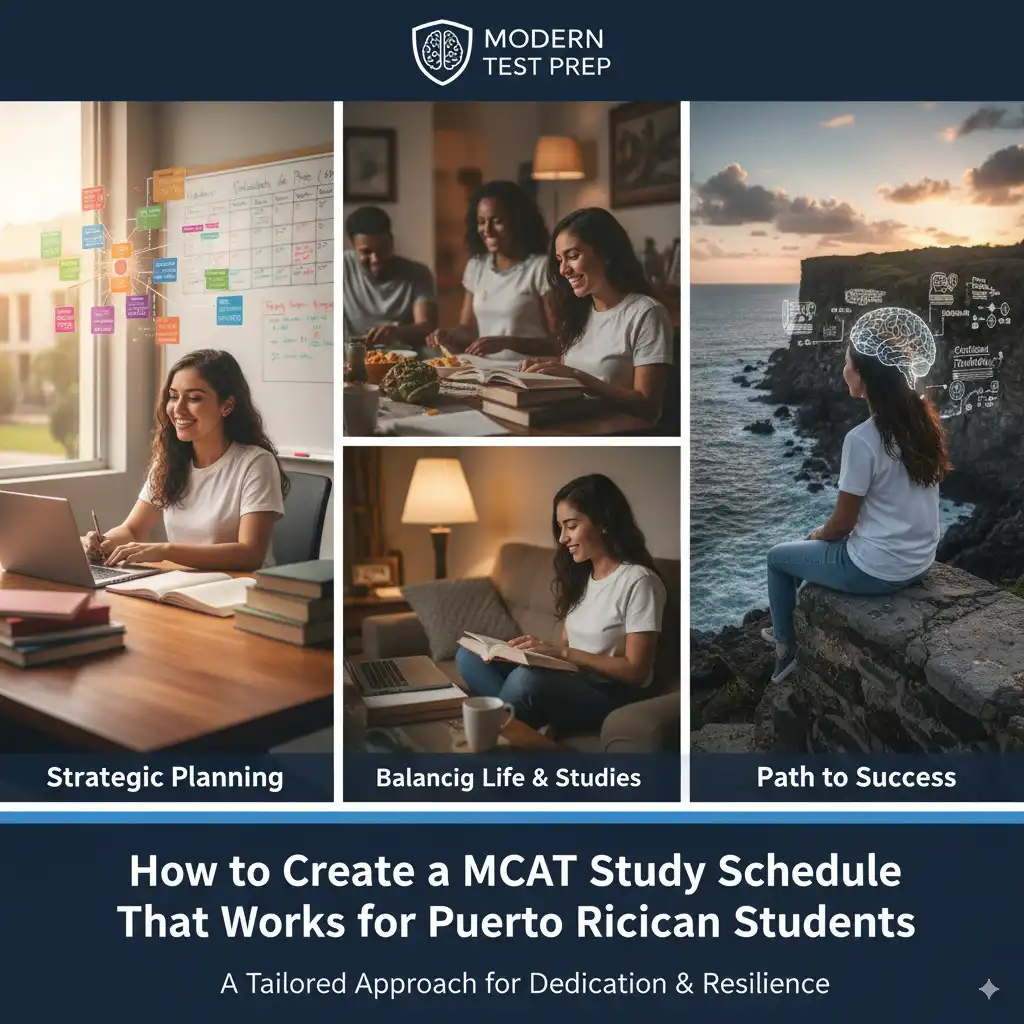
MCAT Study Schedule That Works for Puerto Rican Students For pre-med students in Puerto Rico, the journey to medical school is a marathon of dedication, resilience, and strategic planning. The Medical College Admission Test (MCAT) stands as one of the most significant hurdles on this path. Its vast scope—covering everything from biochemistry and physics to critical analysis and psychological reasoning—requires a study plan that is not just rigorous but also intelligent and adaptable. A generic, one-size-fits-all schedule often leads to burnout, frustration, and subpar results. The unique academic, cultural, and logistical landscape of Puerto Rico demands a tailored approach. Balancing university courses at institutions like UPR or UCC, honoring deep-rooted family and cultural responsibilities, and navigating potential infrastructure challenges like internet reliability are all factors that must be considered. This article provides a comprehensive, step-by-step guide to crafting an MCAT study schedule that is both effective and sustainable for the motivated Puerto Rican student. We’ll move beyond basic advice to provide a framework that respects your context and maximizes your potential for success. Understanding the MCAT Timeline and Your Commitments The first and most crucial step in building your study plan is understanding the battlefield. The MCAT is offered from January through September, but your personal timeline is about more than just test dates. The Ideal Timeline: A comprehensive MCAT prep period typically spans 3-6 months of dedicated study. This does not include the time you are simultaneously taking full-time university courses. The key is to start early. Ideally, you should begin planning your schedule 8-10 months before your intended test date. This allows for a gradual ramp-up of intensity. Mapping Your Commitments: Take out a calendar—a digital one like Google Calendar works best for its flexibility. Block out all your non-negotiable commitments for the entire preparation period: Seeing this visual representation of your time is often a reality check. It helps you identify your true available study hours and avoid the common pitfall of overestimating your available time. Assessing Your Strengths and Weaknesses in MCAT Subjects You cannot create an efficient schedule if you don’t know where to focus your energy. Before you dive in, you must conduct an honest self-assessment. Take a Diagnostic Exam: Before you open a single review book, take a full-length, timed MCAT practice test from the Association of American Medical Colleges (AAMC) or a reputable prep company. This is your baseline. It will be humbling, but it is the most valuable data point you will get. Analyze the Results: Don’t just look at the overall score. Break it down by section: Identify which sections are your weakest and which are your strongest. Within those sections, note the specific topics you struggled with (e.g., thermodynamics, optics, genetics, sociology theories). Your schedule should allocate significantly more time to your weaknesses while maintaining your strengths with periodic review. Balancing Study Time with University Courses in Puerto Rico Juggling MCAT prep with a demanding course load at UPR, UCC, or another university is your biggest challenge. The key is integration, not separation. Strategic Semester Planning: Time Blocking is Your Best Friend: The concept of “I’ll study when I find time” is a recipe for failure. You must make time. Incorporating Cultural and Family Responsibilities This is perhaps the most distinctive aspect of creating a schedule for a Puerto Rican student. Family and community ties are strong and central to life. Ignoring these responsibilities to study is not only culturally insensitive but will also lead to guilt and burnout. The solution is to plan for them. Communicate Your Goals: Sit down with your family and explain the importance of the MCAT, your goals, and the time commitment required. Help them understand that this is a temporary period of intense focus. When they understand the “why,” they are more likely to support your need to sometimes say no or to study while everyone is socializing. Schedule Family Time: Just as you schedule study blocks, proactively schedule quality family time. Block out Friday nights for dinner or Sunday afternoons. Being fully present during these scheduled times will alleviate guilt and make it easier to protect your study times. It also ensures you maintain the crucial social support system you’ll need during this stressful period. Leverage Cultural Strengths: Use your environment to your advantage. The concept of “community” can be a strength. Form a study group with other pre-med students. You can hold each other accountable, quiz each other in Spanish and English to ensure true understanding, and provide mutual emotional support from people who truly get it. Utilizing Online Resources and Flexible Learning Modern Test Prep’s philosophy is built on the power of flexible, digital learning to overcome geographical and logistical barriers. This is especially relevant for students outside the San Juan metro area or those with irregular schedules. On-Demand Video Libraries: Utilize resources like Modern Test Prep’s pre-recorded video classes. Their power lies in their flexibility. You can watch a 45-minute lecture on metabolic pathways at 10:00 PM after your lab ends or on a Saturday morning at your own pace, pausing and rewinding as needed. Digital Flashcards and Question Banks: Spaced repetition software (SRS) like Anki is a game-changer. It creates a personalized review schedule based on what you’re about to forget, maximizing the efficiency of your memorization for topics like psychology terms and equations. Use it during short breaks between classes or while waiting for an appointment. Virtual 1-on-1 Tutoring: This provides personalized guidance without the need for a long commute. You can get targeted help on your specific weaknesses, whether it’s a CARS strategy session or a deep dive into physics concepts, all from your home, saving you precious time and energy. Adapting Your Schedule for Maximum Efficiency Your study schedule is a living document, not carved in stone. You must regularly assess its effectiveness and be willing to adapt. The Pareto Principle (80/20 Rule): Apply this to your studying. Identify the 20% of topics that will yield 80% of your score improvement. Often, this means